Plant of the Week: The Venus Fly Trap
BUGS BEWARE!
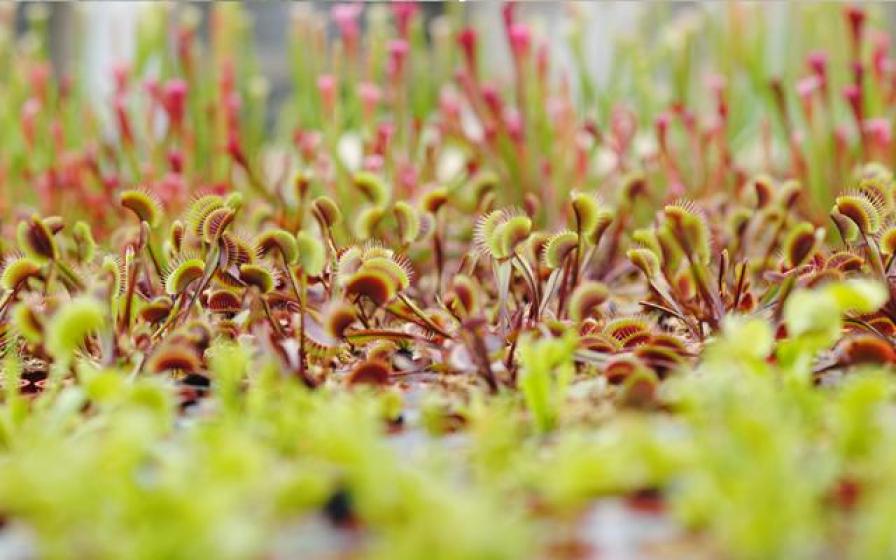
Like other plants, Venus Fly Traps gather nutrients from gases in the air and nutrients in the soil. However, they live in poor soil and are healthier if they get nutrients from insects. Carnivorous plants live all over the world but the Venus Fly Trap is native to select boggy areas in North and South Carolina. Because of people’s fascination with these plants, they collected many of them and they became endangered. Today, Fly Traps are grown in greenhouses.
The leaves of these mysterious plants open wide and on them are short, stiff hairs called trigger hairs. When anything touches these hairs enough to bend them, the two lobes of the leaves snap shut trapping whatever is inside – in less than a second. If the object isn’t food, e.g., a stone, or a nut, the trap will reopen in about twelve hours and ‘spit’ it out. The trap constricts tightly around the insect and secretes digestive juices, much like those in your stomach. It dissolves the soft, inner parts of the insect, but not the tough, outer part called the exoskeleton. At the end of the digestive process, which takes from five to twelve days, the trap reabsorbs the digestive fluid and then reopens. The leftover parts of the insect, the exoskeleton, blow away in the wind or are washed away by rain. The time it takes for the trap to reopen depends on the size of the insect, temperature, the age of the trap, and the number of times it has gone through this process. People still do not understand fully how the trap closes. The Venus’ Flytrap does not have a nervous system or any muscles or tendons. Scientists theorize that it moves from some type of fluid pressure activated by an actual electrical current that runs through each lobe.
The Venus Flytrap is one of the easiest carnivorous plants to grow — with only a few requirements such as, wet roots, high humidity, full sunlight, and poor, acidic soil.A recommended soil mixture is one that contains sphagnum moss and sand. Do not add fertilizer or lime. Your plants will do better if you transplant them into new soil every few years. To provide high humidity, plant it in a terrarium or in a glass container with a small opening. An old aquarium or fish bowl make good containers for this purpose. You need to watch your terrarium in the summer because the temperature inside the glass may get too hot. Two hours in the sun may be sufficient. If your plants wilt, then they need to come out of the sun sooner. Just the opposite is true for winter. If it gets very cold in your area you may need to move your plants away from the window or cover them at night in order to keep them warm and moist. However, it will experience a dormant period in the winter, from Thanksgiving to Valentine’s Day so it needs fewer hours of daylight and cooler temperatures. If you grow your plant outside, it will get enough insects to eat. If it rains the container may fill up with water but this will not hurt the plants, they can live underwater for months. If you grow your plant inside you will need to feed it insects. A couple of houseflies or small slugs per month is enough during the growing season. source: botany.org
Bring your kids to learn more about these carnivorous plants at our Venus Fly Trap Workshop for Kids on Saturday, August 15 at 11am. learn more >>
Check out more of our favorite plants! OUR PLANTS OF THE WEEK >>