How Well Do You Know Your Crepe Myrtle?
CREPE MYRTLE FACTS & FICTION
With our 32nd Crepe Myrtle Fest upon us, we’ve put together some info to see how well you know your Crepe Myrtle. Check out the facts and fiction of this local favorite and don’t forget to come out this weekend and save big on Crepe Myrtles and much, much more!
All Crepe Myrtles grow into trees.
FALSE: Crepe Myrtle breeding has given us a wide range of sizes. Some are as small as a few feet tall, like Pocomoke, while others grow to medium-sized trees capable of providing summer shade like Natchez. Some Crepes are small enough to act as a ground cover like the Orchid Cascade variety. There’s a Crepe Myrtle for every size yard.
Crepe Myrtles bloom for 100 days.
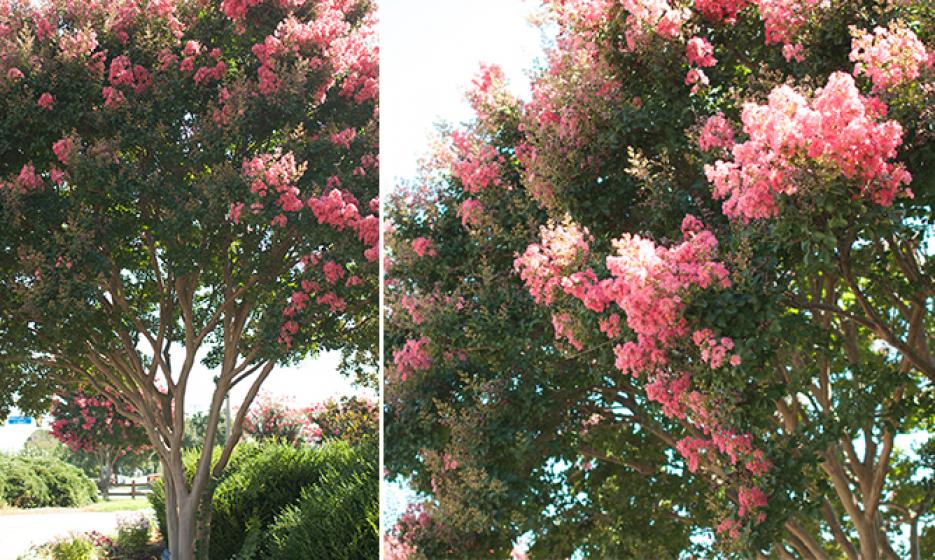
TRUE: Crepe Myrtles are known as the ‘Tree of 100 Days’ due to the fact that they bloom from June into September.
Crepe Myrtles are a multi-season interest plant.
TRUE: These deciduous plants produce crepe-like flowers all summer, then have great orange-red fall color. During cold winter months, many varieties display a unique, cinnamon-colored bark that stands out in the landscape. In a nutshell, Crepe Myrtles look great all year long!
All Crepe Myrtles are disease resistant.
FALSE: Many of the older varieties do not have the improved breeding from Dr. Donald Egolf of the National Arboretum. Dr. Egolf first worked with Lagerstroemia indica for breeding and selection in hopes of eliminating the problem of powdery mildew. From that initial work, 6 varieties were chosen with improvements and these were given Native American names so that these plants would be recognized worldwide as having American Heritage. His work further continued with cross-breeding with Lagerstroemia fauriei which gave us many of today’s newer hybrids such as Natchez, Tuscarora and Tonto. It is important to select newer improved varieties to replace the older disease prone selections.
Crepe Myrtles love the heat.
TRUE: Crepe Myrtles love the hot summers of our area and are the perfect addition for carefree summer color.
Crepe Myrtles are not picky about the soil they are planted in.
TRUE: Crepe Myrtles are adaptable to a wide range of soil conditions and can perform even in poor soils.
Crepe Myrtle is spelled with an “e.”
TRUE: In the McDonald Garden Center dictionary, we spell Crepe Myrtle with an “e” based on the tissue-paper like flowers that resemble the ‘crepe’ paper texture.
Crepe Myrtles can flower in the shade.
FALSE: For maximum flowering, Crepe Myrtles must have a full sun location – meaning at least 6 hours of sun daily. Less than that will mean less flowers.
Crepe Myrtles need to be dead headed.
FALSE: It is not necessary with the newer selections to remove old blooms before they go to seed to produce new flowers. Re-current flowering is one of the benefits achieved with new selections and they are free flowering through out the summer.
Join us as we celebrate this local favorite this weekend at our 37th annual Crepe Myrtle Fest, July 19-21.