Take the frost out of frostbite…
WINTER CARE TIPS
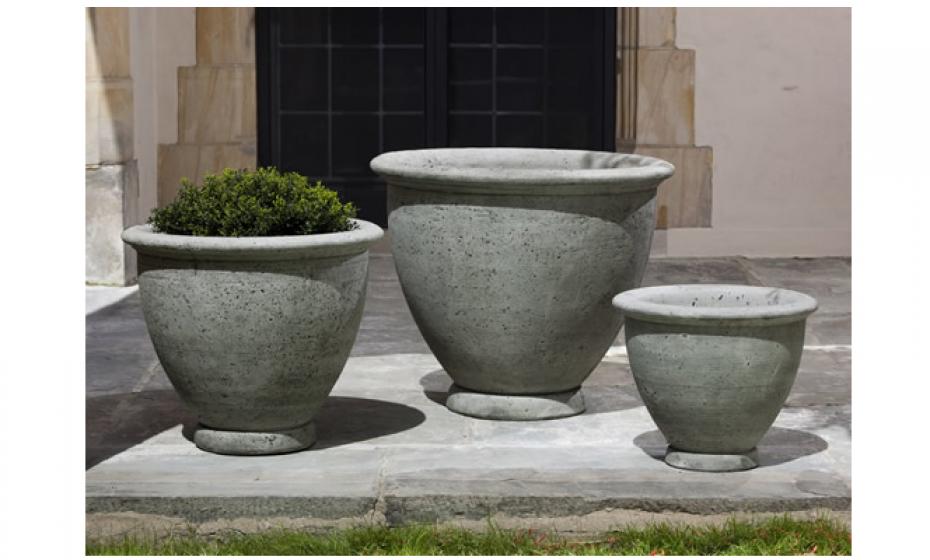
Though cast stone consists of a high density mixture designed to produce a strong and durable product, proper maintenance is recommended to protect your product from the freeze-thaw cycles that occur this time of year. Any piece which can hold water, snow or ice, such as a planter, birdbath/fountain top, and any piece which is placed directly on the ground, such as a statue, birdbath/fountain base, planter or bench leg, can be damaged by the winter freeze-thaw cycles. To minimize any possible winter damage, please follow the simple suggestions listed below.
Cast Stone Planters:
If a planter is to be left planted over the winter, it should be raised up off the ground by placing two pressure treated wood strips underneath the planter, making sure not to block the drainage hole. This will allow the soil to drain and will prevent the planter from freezing to the ground. If a planter is placed directly on the ground and goes through several freeze-thaw cycles, drainage may be blocked. This may cause an expansion of the soil inside the planter, which in turn may cause the planter to crack or crumble. We always recommend that drainage materials such as small stones or terra cotta chips be placed at the bottom of the planter before filling with soil to ensure proper drainage.
If a planter is not to remain planted over the winter, we suggest that it be stored in a covered area where it will be protected from the elements. If a planter must be left outside unplanted, we suggest that you empty the soil and turn the planter upside down onto wood strips. Cover or wrap the planter with burlap or any absorbent material (old blanket/towel) and then wrap with dark plastic. This will prevent moisture from accumulating in the planter. Please note that even if a cast stone container is raised off the ground, there is always the risk that the container will absorb water through its surface which, when frozen, can cause the planter to crack or break.
Birdbaths, Fountains, Benches & Statuary:
We suggest that birdbath/fountain tops not be left outside in the winter. Once the top fills with water/snow and freezes, the top may crack. All birdbath/fountain bases, bench legs and statuary should be raised up off the ground in winter so they will not freeze to the ground surface.
Ideally, a fountain should be stored indoors in the winter away from the elements. However, if a fountain bowl must be left outside, remove all pumps, rubber stoppers, drain pipes, finials and small components, and cover the top in accordance with the planter instructions above, making sure that water does not accumulate in the basin and freeze. Fountain pumps, finials, and other small components should be stored indoors. Check the fountain periodically to insure that the cover is secure and water is not accumulating in any fountain component.
Glazed and Terra Cotta:
Terra cotta and earthenware are always slightly porous. Although this allows plant roots to breathe, it also constitutes a risk in winter. When the temperature drops below freezing, any water present in the pot walls will freeze and expand. This will cause the pot wall to spall and can ultimately destroy the pot.
Whether this actually happens or not, depends on the quantity of water that can be absorbed by the fired clay. This, in turn, depends on the quality of the clay and the way it has been processed.
Machine-made terra cotta planters can absorb a lot of water and are the most vulnerable to winter damage. Hand-made containers, like those offered by Campania, absorb far less water because the clay is processed differently. They are frost-resistant if handled correctly. However, because any water held in a pot from rain or melting snow will freeze and expand, any pot made of a non-elastic material is at risk if left outside unprotected in winter.
Accordingly while the high firing temperature and quality of our glazed and terra cotta containers results in a durable and frost-resistant product, we still recommend that they be stored in a frost-free covered area in winter. If left out, water may accumulate in the container and freeze, causing the planter to crack and break.