Celebrating Black History Month, Norfolk Botanical Gardens
To celebrate Black History Month, we are highlighting some of the many contributions of African-Americans to the horticultural industry. Today we share a story especially important to the Hampton Roads community, the story behind the WPA Memorial Garden located in the Norfolk Botanical Gardens.
Content from Norfolk Botanical Garden
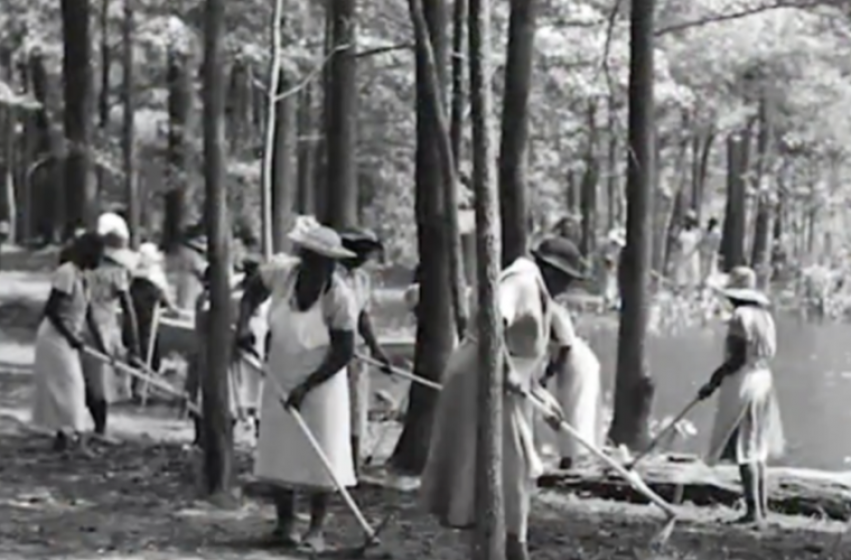
The idea for the eventual Norfolk Botanical Garden came from City Manager, Thomas P. Thompson. Because the climate of Norfolk was uniquely suited to azaleas he believed a garden could be created to rival those of Charleston, S.C., which even during the depression drew tourists to their city. On June 30, 1938, the Works Progress Administration (WPA) awarded a grant of $76,278 to begin the project. It began as Azalea Gardens. Since most of the male labor force was at work with other city projects; a group of 200 African American women and 20 African American men received the assignment.
Laboring from dawn until dusk, the workers cleared dense vegetation and carried the equivalent of 150 truckloads of dirt by hand to build a levee for the surrounding lake. For a period of four years, the 220 original workers continued the back-breaking task of clearing trees, pulling roots and removing stumps. They worked in harsh conditions, long hours during all four seasons, regardless of the blistering heat, humidity, rain, finger-numbing cold, snow or frigid temperatures. They battled snakes, mosquitoes, ticks, and poison ivy. In less than a year, a section of the trees, briers, vines and underbrush had been cleared and readied for planting, using only pickaxes, hoes, shovels, and wheelbarrows. By March 1939, the work had progressed so that 4,000 azaleas, 2,000 rhododendrons, several thousand camellias, other shrubs and 100 bushels of daffodils had been planted. The men and women turned overgrown, swampy acres into a garden that stylistically expressed the national trend of landscape architecture during the late 1930’s. Neither the work nor the pay was great, but it was a means of putting food on the table, which would not have been possible otherwise.
To watch and learn more about the WPA Memorial Garden click here.
We’d like to thank Norfolk Botanical Garden for the information, photo and video.
To help maintain the WPA Memorial Garden, please consider donating to the Norfolk Botanical Gardens.